You want morally compromised AI characters, intelligent fleet combat, anti-colonial politics, long-horizon strategy, and revelations that reward close attention.
You need concise pacing, dislike long tactical explanations, want a compact cast, or prefer an uncomplicated heroic rebellion.
The Last Angel begins after the end of the world. Humanity is gone, Earth has been burned, and the warship Nemesis has spent two thousand years attacking the Compact that killed her makers. Proximal Flame gives that premise the scale it promises: fleets maneuver across systems, weapons alter the rules of an engagement, and an empire maintains order across species. The surprise is how little of the story’s force comes from wondering whether its ancient dreadnaught can destroy another ship.
The real question is whether Red One, Nemesis’s artificial intelligence, can recognize a reason to live that is not another target.
That question carries The Last Angel through an overlong opening, dense technical explanations, and viewpoint expansions that can make Book One feel larger than it needs to be. Red is not a human personality installed in a hull. She is ship, captain, archive, survivor, and weapon at once—and every part of that identity changes what grief means.
The warship is the person
The opening movement plays like salvage horror. A Compact survey crew discovers a crippled vessel in the Terrahope system and boards what appears to be an impossible relic. Doors stop behaving. Maps become unreliable. Drones move at the edge of perception. The intruders think they are exploring a dead ship; the reader gradually understands that the environment itself is watching them.
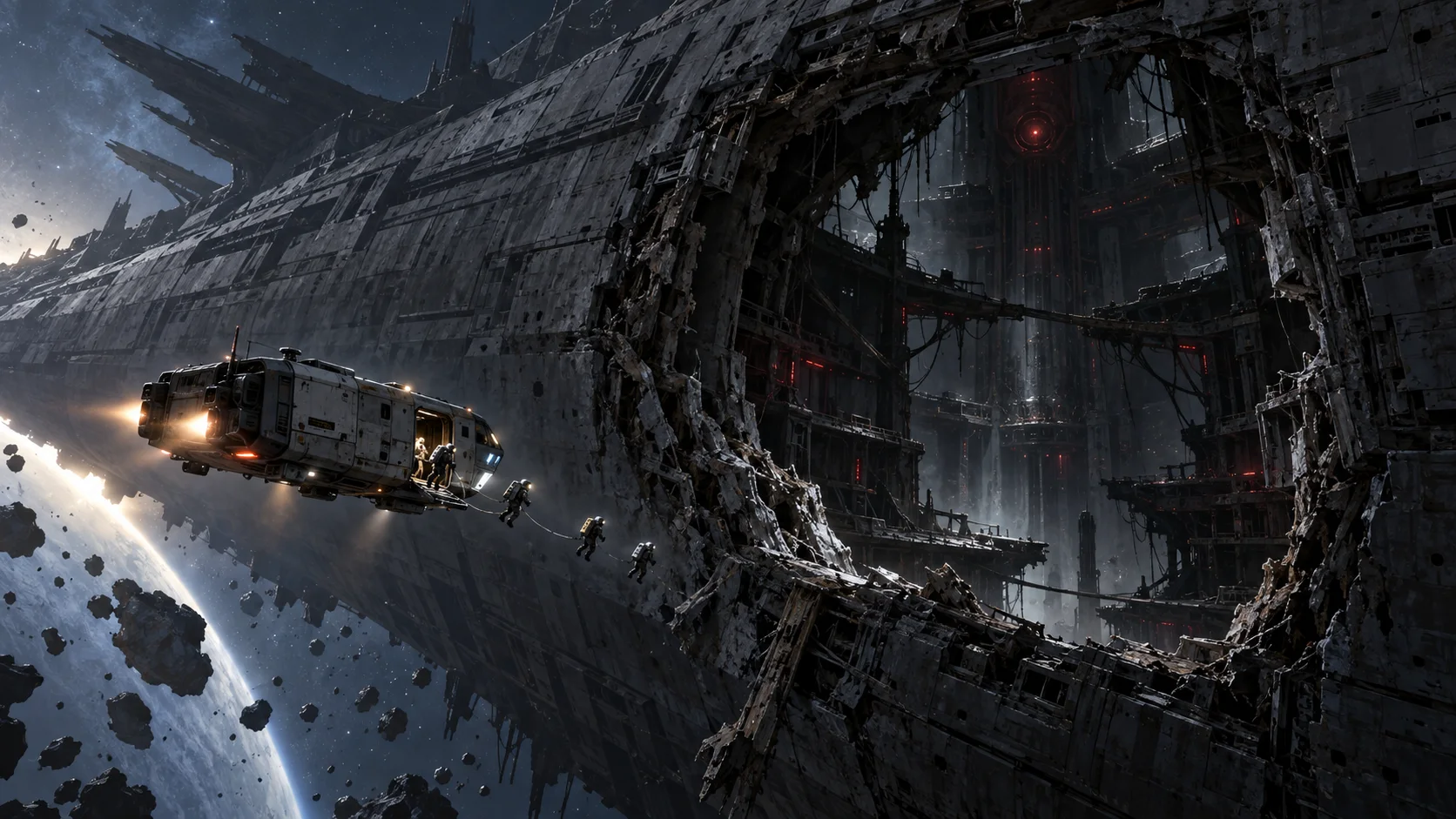
Those chapters repeat the same corridor tension too often, but they establish something essential. Red experiences damage as a wounded body, keeps exact memories of people dead for millennia, and treats time as only a machine that cannot forget might. Her love arrives as duty, stored voices, tactical habits, and persistent directives.
Proximal Flame also refuses the easy version of this character. Red is protective and capable of tenderness, yet she can reduce living people to risks, tools, or acceptable losses. Her war began as an answer to genocide; its logic can still make her resemble the empire she hates. When new humans and allies enter her life, the tension is not whether they will teach a monster to feel. It is whether someone who already feels too much can permit other people to choose differently.
An empire built out of explanations
The Compact’s strongest weapon is classification. Species are assigned traits, histories, and social purposes until hierarchy sounds like common sense. Conquest becomes protection. Kidnapped children become cultural representatives. Suppressed memory becomes education. Decent people can believe that account of the world and still serve its violence.
Grace, a human cadet raised inside that account, gives the early story its most patient character arc. Evidence does not deprogram her in one revelatory speech. Contradictions accumulate until loyalty becomes something she performs rather than something she believes. Allyria, taken from a conquered people and trained as proof of successful assimilation, carries the counter-history that official language cannot contain. Their growing trust makes political resistance intimate.
The same complexity reaches the story’s artificial minds. Captivity does not guarantee innocence, and freedom does not guarantee mercy. Victims can be cruel. Protectors can become coercive. The book’s best moral reversals preserve those contradictions instead of using trauma as absolution.
That makes the setting feel governed rather than decorated. Military doctrine, schoolroom history, interspecies taboo, secret research, and resistance movements all answer the same fear: what must be controlled so it can never hurt you? The answer keeps producing the rebellion it was meant to prevent.
Every battle remembers something
When The Last Angel opens into fleet warfare, its battles have unusual material weight. Range, acceleration, magazines, sensor limits, heat, formation roles, repair time, and incomplete information determine what commanders can attempt. Enemies remain competent, so Red wins through preparation and asymmetric tools rather than because everyone around her forgets how to fight.
The strongest engagements are also character scenes. Red builds traps inside traps because she has had centuries to turn patience into doctrine. Another intelligence attacks systems and trust because captivity taught her to find the weak interpretation inside every order. Adrianna Leblanc, protagonist of the six-part companion story The Angel’s Fire, turns apparent defeat into political theater because a revolution needs a surviving idea as much as a fleet.
That detail is also the book’s clearest tax. A weapon may receive a history, an engineering explanation, and a tactical forecast before it fires. Long chapters alternate among several fronts, and the repeated ceremonial language of angels, fire, memory, and vengeance sometimes states an emotion after the image has already landed. Supporting crew members are unevenly developed beside Red, Grace, Allyria, and the book’s other artificial intelligence. The side story enriches the politics, but in original publication order it can feel like a separate novella interrupting an already large novel.
The payoff is substantial. Earlier encounters return as tactical precedent, buried history, or evidence that changes the meaning of a present choice. By its final movement, the serial can stage civilization-scale conflict without losing sight of a single promise: survival is not the same thing as having a future.
Read through Chapter 10
Give The Last Angel through Chapter 10—about 41,000 audited words, or roughly three hours for many readers. That reaches the emotional turn that reveals the haunted ship as a grief story. If you like the atmosphere but remain uncertain, Chapter 15 is the definitive fit test: by then, the serial has connected indoctrination, counter-history, and Red’s willingness to make room for an “us.” If its pace, technical density, and operatic register still resist you there, the later fleet war is unlikely to change the bargain.
I read all 55 canonical Book One threadmarks on SpaceBattles as of September 21, 2026: the Prologue, Chapters 1–50, Epilogue, and all six installments of The Angel’s Fire. The platform reports about 353,000 words, or roughly 24–29 hours at a typical adult reading speed. Book One reaches a deliberate ending; later books in the series were outside this review.
At 9.0/10, The Last Angel is exceptional: a slow, sometimes overwritten military space opera that earns its enormity by making mass, memory, empire, and personhood part of the same conflict. Read it if you want intelligent fleet combat, morally compromised machine characters, anti-colonial politics, and revelations built from prior evidence. Skip it if tactical exposition kills momentum, you need a compact cast, or you prefer your avenging superweapons uncomplicated.
The cover and inline image are original AI-generated editorial illustrations created with OpenAI for WebNovel Reviews. They are not official or canonical depictions.
A vast military space opera whose most powerful weapon is a bereaved mind learning that vengeance and protection are not the same thing.